


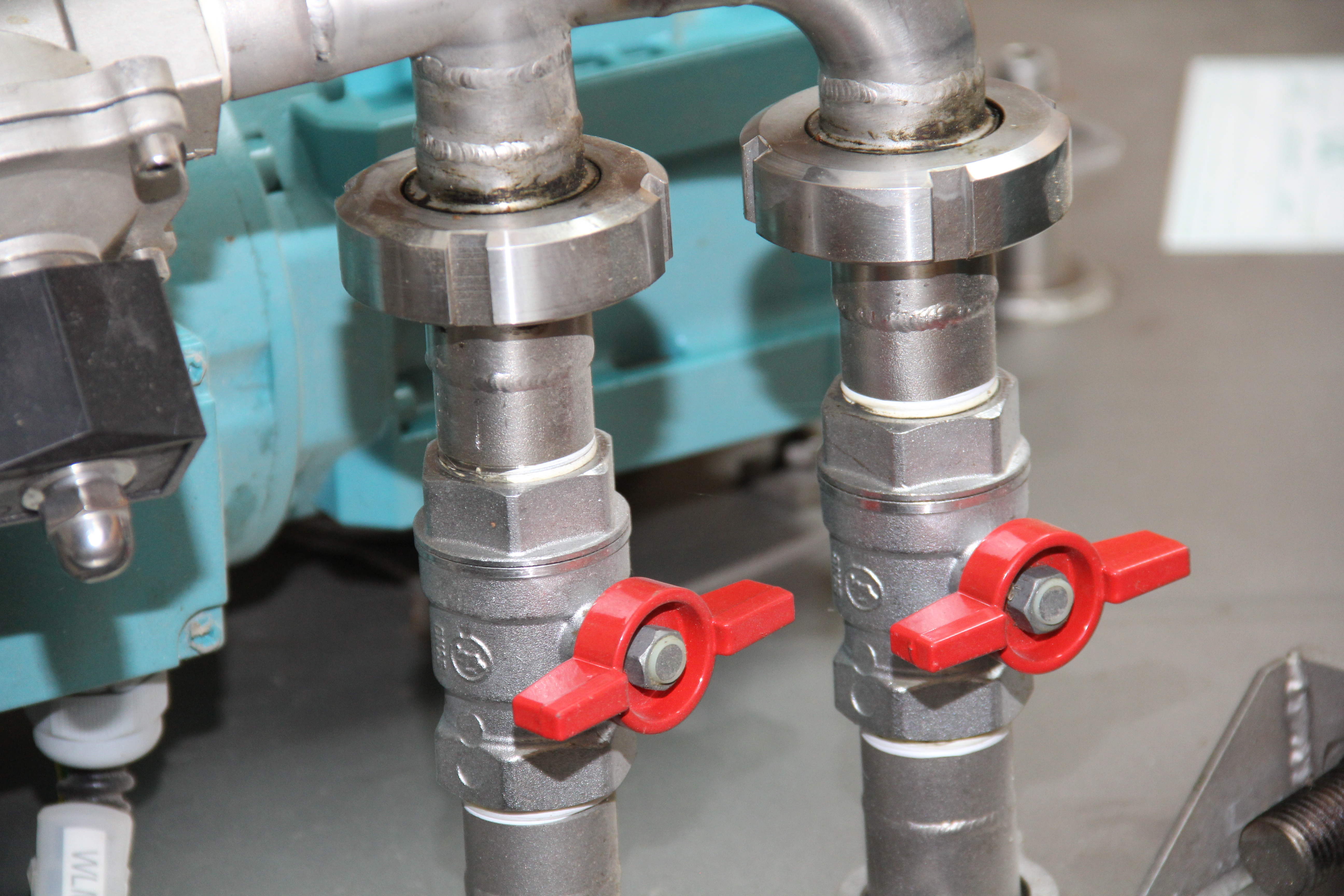
What and how to set. You probably received instructions from the manufacturer or were trained. If the cleaner still doesn't work for you, it would probably be best to contact the manufacturer. If none of this helps, you may find the following article helpful. Again, there are many variants of treatment plants and it is not possible to describe them all separately. The recommendations below are rather general in nature and will probably need to be adapted to a specific model of treatment plant. In any case, it is advisable to first know the principle of the activation treatment plant.
wastewater inflow
This will depend a lot on the specific model. Most likely, the water is flowing directly into your activation. Then you can skip this chapter straight away.
If your water flows into a leveling or sedimentation zone, there are options with or without wastewater pumping and with or without aeration of this zone.
Pumping
Pumping should be even. In other words, either pump a smaller amount more often, or set the mammoth so that when the sump is full, it flows in a stream, with an uninterrupted burst of air from the mouth of the pipe, and at the same time so that the stream is not so small that only occasionally a little trickles out. This only happens when the level drops by approx. 30-50 cm, and that's fine, because the principle of equalizing the flow is based on it - the lower the water level in the sump, the less is pumped and vice versa.
Aeration
It is important here not to confuse the buffer tank with the activation tank. If the sump is to serve as a settling tank, do not aerate it! (an exceptional situation is when the biology of the wastewater treatment plant does not have enough organic substrate, but I'd rather talk about that somewhere else). If it is to be something more like a sand trap (look in the manufacturer's instructions), then aeration is suitable. Slight aeration should ensure that organic matter is washed out of the captured sand as food for the bacteria in the next stage, leaving only sand, which has a higher density, in the tank.
Mammoths/Pumps
Return sludge
Return sludge is pumped by a mammoth at most domestic treatment plants. If you have the sludge pumped by another pump, it should be ensured that ideally the pump runs continuously, or its operation is interrupted (For example, 15 minutes running and 15 minutes pause is not a bad mode. Longer breaks are not recommended, shorter ones are). Intermittent operation is not suitable for a mammoth, on the one hand, it has less power and then it can clog to an increased extent. The flow rate should be set so that the mammoth gives a continuous stream of water. It should not be interrupted by either a lack or an excess of air. The mammoth pumps approximately the same volume of air as the volume of exhausted water, but this has its limits given, for example, by the width of the pipe. It is optimal when the mammoth gives a stream of sludge occupying about 1/3 of the cross-sectional area of the pipe.
Floating substances from settling tank
Some treatment plants are equipped with the removal of floating substances from the level of the settling tank. This is usually switched periodically by the control unit. We do not recommend continuous operation, as this reduces the capacity of the settling tank for wastewater, and in extreme cases it may fail and the sludge may leak into the drain. Relatively reasonable times are, for example, a 5-minute run and a 1-hour break. Or other - it needs to be traced according to the amount of floating substances on the surface of the settling tank. The amount of water withdrawn, especially if it is realized by a mammoth, is such that in the funnel where the water flows, floating substances are safely sucked in.
Lower the level before downloading floats
Some treatment plants have a function for pumping out the treated water before removing the floating substances. The same applies here as for other mammoths, i.e. set the optimal flow rate. Otherwise, you can experiment with the length of this phase, it is better to stick to the manufacturer's instructions.
Sludge to storage sump
If you have a sludge pit, it is advisable to drain it regularly and keep the sludge volume at 300-500 ml after 30 minutes of sedimentation. Again, the same applies here as for the return sludge mammoth. automatic dewatering makes sense at larger treatment plants. On small ones, we recommend not to delay more than about 20% of the activation volume.
Air
There are many uses for air in a treatment plant. Some have already been described above, they are primarily pumps, so-called mammoths. Furthermore, the air is used for mixing and for the supply of oxygen to the bacteria.
Mixing
Mixing is very important in activated sludge tanks. The intensity of the air supply must be such that the sludge does not settle anywhere (except the settling tank). Sludge that sits at the bottom begins to rot, then the biogas lifts it up and can clog pipes, create crusts on the surface, and damage bacteria. This is especially true for air-mixed denitrification zones.
In treatment plants that have combs or a comb basket under which air is blown, it is advisable to set the aeration level so that suspendable (typically paper and faeces) particles are gradually pulverized and can be biologically removed.
Stirring of settling tank is not suitable. Here, the sludge is supposed to settle and mixing prevents it. If you have settling tank aeration, it is better to leave it off. This is only suitable for exceptional cases, during some maintenance. But do not confuse mixing the entire volume of the spreader with aerating the surface. This is placed a few centimeters below the surface and should generate small ripples that move the floating substances to the suction cup, which pulls them from the surface and removes them. So set a gentle bubbling here.
If you have aeration of the central cylinder of the settling tank, set the intensity so that after a week this cylinder is not clogged with floating sludge. It's not exactly a gentle bubbling, but it's definitely not a geyser either. Let's say medium intensity bubbling.
Aeration - supply of oxygen
In addition to a functional return sludge recycle, it is crucial that the bacteria have enough oxygen to break down the pollution. This is ensured by (usually) a fine-bubble aeration system. In addition to the supply of oxygen, this must also ensure mixing. Therefore, adjust the air so that the jet is fairly intensively mixed, but so that a complete geyser does not form, or that the water does not spray. In general, if you don't know where to go with the air, let it activate.
Most treatment plants have a time mode set for aeration. This can be either through a control system or some hours into the socket. It is necessary to blow so that the sludge retains its brown color and the treatment plant does not smell. If it darkens, it usually indicates a lack of oxygen. The less loaded the treatment plant is, the less oxygen it needs. Therefore, if you have a treatment plant for 6 residents, but there are only 2 of you, it is possible to set the time, for example, so that the treatment plant is aerated for 30 minutes and then there is a 30-minute break. If you have a control system, then maybe 10/10. Here, a lot will depend on the specific type of treatment plant and local conditions. In the case of abnormally high inflows to the treatment plant, e.g. during holidays, it is better to use permanent aeration, on the other hand, if you are going on vacation and the treatment plant will have no inflow, then you can easily set the aeration for example for 15 minutes after 2 hours or longer. However, expect the formation of denitrification foam, which you will have to remove after your return. We strongly do not recommend breaks longer than 8 hours.
Precipitation of phosphorus
Precipitators based on iron or aluminum can be used to precipitate phosphorus. Usually ferrous sulfate (we recommend this one - it's cheaper) or PAX (polyaluminum chloride). A person produces about 2.5 g of phosphorus per day. The dose can be calculated stoichiometrically, but since part of the phosphorus is also bound biologically, it is better to base it on operational experience. From these, it follows that approximately 7 ml of ferrous sulfate, or 5.5 ml of PAX, should be dosed per equivalent resident per day.
Dosing is then implemented in different ways, either by a peristaltic (hose) pump or directly by a membrane dosing pump. Here it is good to calculate, or measure, or find in the manual how much the pump dispenses per time and either adjust the dose so that a sufficient amount is dispensed per day, or, if the operation of the pump is controlled by time, so that the daily dose is sufficient.
Example:
3 residents are connected to the wastewater treatment plant. The peristaltic pump dispenses 1 ml in 10 s. Its operation is controlled by time. We dose ferrous sulfate.
For 3 inhabitants, the required dose is 3×7 = 21 ml/day. For an overdose of 21 ml, we need 210 s of pump operation. We will dose, for example, every three hours. That's 8 servings per day. 210/8 = 26.25. So we need the pump to run for approx. 26 s with each dose. So we set the pause length to 3 hours and the pump run length to 26 s.
It is very useful to get a kit for the determination of phosphates and adjust the dose according to the result.